No Small Talk
The big models of the past couple of years do everything by running their mouths. Poems, code, weekly reports: they spit it all out word by word, and the more they spit, the longer the bill.
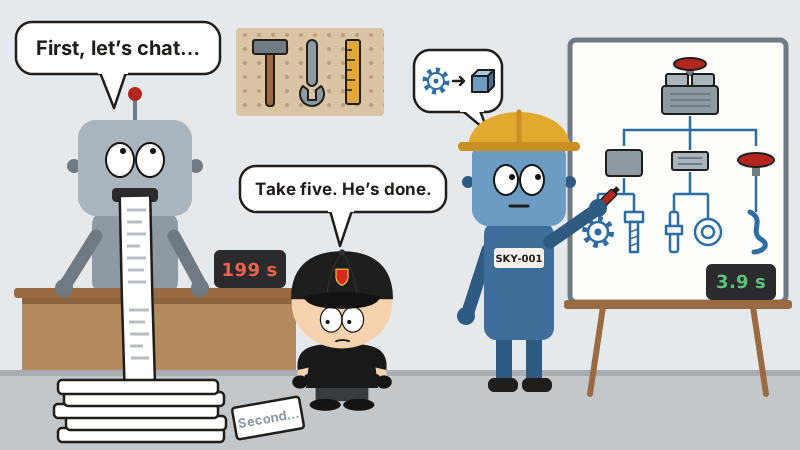
Ask one to design an engine and it’s the same routine: first it spits out a Blender script, then the software draws the thing by following the script. It’s like calling a stand-up comic to fix your car. He might even get it running, but first you’re sitting through his opening five minutes.
A little while back, a small company called Skyfall AI released SKY-001, which goes the opposite way: not one token out, it just starts drawing. No small talk.
What it is
Skyfall AI is headquartered in San Francisco with a research center in Toronto, and only showed its face this July. Its investors include Fidelity, Touring Capital, M13 and iNovia Capital. Of the three founders, Sam Pasupalak and Kaheer Suleman co-founded Maluuba back in the day, which Microsoft bought in 2017 and turned into its research lab in Canada; Sumit Pasupalak ran a Y Combinator-backed company. According to the website, it’s 25 people in all, engineers and researchers combined.
On October 19 they released SKY-001, billing it as the first “engineering world model.” The CEO says it was 18 months of work.
So what’s a world model? The official technical blog spells it out: other people’s world models generate environments for you to look at and wander around in; this one generates designs, plus the step-by-step process of building them.
This company has never been shy about big talk. Just this summer it announced it would spend up to $1 million buying a small software company and hand it over to AI to run. SKY-001 is the first step toward their big goal of “AI that runs a business on its own,” taken in engineering design.
Step one: take it apart
Engineers never design anything complicated in a single stroke. An engine breaks down into hundreds of parts, plenty of them tucked away inside the bellies of other parts. So it goes layer by layer: first the whole machine, then the assemblies, then how each part gets made.
SKY-001 does the same. The first stage is called the Hierarchical Composer. Give it a photo and it first generates a rough 3D shape of the whole thing, just enough to tell what it’s made of. Then it starts taking it apart: the machine into a few big assemblies, each assembly into smaller ones, until every piece is a single part.
Their showcase is a VMS-85 engine, from nothing but a photo: cylinder block, cylinder heads, the intake topped by an air filter, the exhaust pipes, the timing drive up front, and further in, housings, gear sets, shafts, hoses and sleeves. Five levels deep in all.
A rough shape is still rough, though. The surface is lumpy, the stuff hidden inside simply isn’t there, and the parts that come out of it are broken and hollow. So once it’s taken apart all the way down, there’s one more pass: completing every part and adding the details.
Who didn’t take apart an alarm clock as a kid? Couldn’t get it back together, three screws left over on the table. This one’s different: while it’s taking things apart, it’s already thinking about how they go back together.
Buildings work the same way. Give it the outline of one floor’s exterior walls plus a description: how many bedrooms and living rooms, how much floor area, roughly where each room goes. It lays out the walls and corridors first, then splits the floor into individual units. Their example is one floor of an apartment building about 29 meters wide, split into three units, with a shared corridor, stairs and an elevator in the middle.
Step two: build it back up, one step at a time
Once everything’s taken apart, how does each part get made? That’s the job of the second stage, the Construction World Model.
Anyone who’s done CAD knows a part isn’t drawn in one stroke either: you sketch a profile and extrude it into a solid, then add sketches, add material, remove material, and finally drill a hole or cut a slot. That’s the order SKY-001 learned: first predict what the part looks like after each step, then draw the sketch that gets you from one step to the next. In their demo of an engine part, it extrudes the base profile, extrudes once more, then cuts three features. Five steps in total.
Buildings go the same way: exterior walls first, then the walls and corridors between units, then it fills in the rooms one unit at a time and puts in the doors, windows and fixtures. It knows to stop when it’s done, and a whole floor takes about a second.
Under the hood is a diffusion Transformer (DiT), the kind image-generation models often use, not something that blurts out one word at a time. It draws in two passes: first a rough run through the whole sequence of steps in a heavily compressed space, minding only the big layout; then a “restorer” redraws every step in high resolution, bringing back the clean lines, the accurate corners and the small details. Rough sketch first, then ink it in, same as any art student.
Why insist on layers? They ran the numbers: draw everything in one go from start to finish, and every decision tangles with every other decision; over thousands of steps, one small mistake snowballs. With layers, once a level is settled, the work on the level below can run in parallel, the way a construction crew splits up the jobs, and the number of steps grows with how many levels the design has, not with how many parts it has. A decision about one screw still squares with the whole engine hundreds of steps later.
Benchmarks
CAD first. The test set is 1,000 parts pulled from complicated beasts like a Jaguar E-Type sports car, a FANUC robot arm, a little four-wheel-drive tractor, a Bell 222 helicopter and a jet engine. Building one takes a hundred-odd steps on average, and at the end the finished part is scored against the answer key by IoU, which is to say how much the two overlap.
| SKY-001 | GPT-6 Astra | |
|---|---|---|
| IoU | 79.7% | 79.1% |
| Time each | 3.9 s | 199 s |
| Cost each | $0.005 | $0.75 |
That’s 51 times faster and 150 times cheaper, but only 0.6 percentage points more accurate. On the same leaderboard, Grok 4.7 dawdled 1,250 seconds and spent $0.59 per part and didn’t turn in a single one. A thousand blank exam papers.
Next, BIM, short for building information modeling. The test set is 1,000 floor plans, about 350 full floors and 650 single units, averaging 70-some steps:
| SKY-001 | GPT-6 Astra | |
|---|---|---|
| IoU | 43.6% | 40.6% |
| Time each | 1.22 s | 144.6 s |
| Cost each | $0.0024 | $0.446 |
That’s 119 times faster and 186 times cheaper.
One more test compared how they take things apart: from the same photo, SKY-001 and GPT-6 Astra each produced a breakdown, and two big models, GPT-6.1 Sol and Claude Opus 5.5, graded them blind. SKY-001 won on all five scores, 7.8 to 6.4 on the breakdown itself, and GPT-6 Astra came back empty-handed on under a fifth of the questions. AI grading AI: even the exam hall is keeping up with the times.
They did the grunt work on training data, too. On the CAD side, the breakdown model learned from more than 200,000 parts and the build model from more than 600,000 construction sequences, all cleaned up and filled in bit by bit from public datasets. Where a part was missing the “how it was made in the first place,” they worked it out backward with engineering software plus big models, and only used it after it checked out. For a thing that supposedly doesn’t lean on big models, it sure got plenty of help from them.
They also measured themselves against PartVerse, a dataset widely used in the field: the median object in PartVerse has 6 parts; theirs have 288. PartVerse’s BMX bike has 8 parts; their fat-tire mountain bike has 988, with every bit of small hardware and every hidden part counted separately. On the BIM side, they used about 35,000 real and synthetic floor plans, around two million drawing states.
Fair warning
- Own exam, own grader: every score was measured by Skyfall itself, on its own test sets, and nobody has independently reproduced any of them yet.
- The two leaderboards don’t match: for the same CAD test, the product page has Claude Opus 5.5 in third (69.4%) and Gemini 3.8 Flash in fourth (54.7%); the chart in the technical blog has no Opus at all, and its Gemini is Gemini 4 (76.9%). The only rows the two agree on are SKY-001 and GPT-6 Astra.
- The real edge is speed and cost: a 0.6-point lead in CAD accuracy could fairly be called noise. And BIM’s 43.6% means less than half the drawing overlaps, a long way from plans you could actually hand in.
- You can’t use it yet: it’s a research preview, and the website only lets you join a waitlist. The press release says full commercial availability won’t come until early 2027.
- Some of it is still “next steps”: the press release says the output can be viewed in CAD software like Autodesk Fusion. But “change one part and the related parts change with it,” and turning the sketches into a modeling history you can keep editing in CAD, are both listed under “next steps” in the technical blog. For now the output is a sketch and a 3D shape for each step, and they note themselves that the sketches and the 3D geometry sometimes don’t line up.
Parting shots
Engineering design, at bottom, is geometry, hierarchy and constraints, not a language problem. Pitting a purpose-built world model head-on against general-purpose big models is an idea more worth chewing on than any benchmark table.
SKY-001 supposedly skips the talk. But as for how well it really draws, right now we only have its word for it.