Mold Yourself a Munger
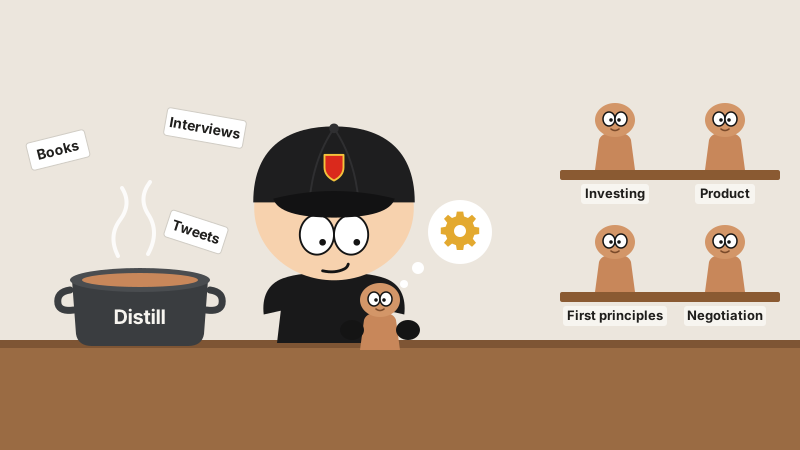
In Chinese myth, the goddess Nuwa made people out of yellow earth. Now there’s an open source project called Nuwa too, and it molds people out of books, interviews and tweets. What comes out isn’t clay dolls. It’s a lineup of advisers ready to tell you what to do.
What it is
It’s called Nuwa.skill (nuwa-skill), by Huashu (alchaincyf on GitHub), the same guy behind the huashu set of skills. It opened in April 2026, has 35,000 stars as of now, and is MIT-licensed.
In one sentence: it’s a skill that makes people. Give it a name, and it digs up everything that person has said and written in public and distills it into a “perspective skill.” Install that, and your AI doesn’t learn to imitate how they talk. It borrows how they think to work through your problem.
As the README puts it, work habits can be passed on with process docs. What’s truly rare is the cognitive framework that makes Munger and Musk look at the same problem and come to different judgments. That framework, the “cognitive operating system,” is what Nuwa extracts.
What gets distilled
Five layers in all:
- How they talk: expression DNA. Tone, rhythm, pet words
- How they think: mental models, cognitive frameworks
- How they judge: rules of thumb for decisions
- What they won’t do: anti-patterns, the lines their values won’t cross
- Knowing the limits: honest boundaries. Whatever isn’t in the public record, it admits it can’t capture
The first four are know-how. The fifth is self-awareness. Honestly, that last one is the rarest.
How it’s brewed
Same method as brewing Chinese herbal medicine, just with a lot more herbs:
- Six streams into one pot: books, podcasts and interviews, social media, what the critics say, key decisions, and the life timeline. Six agents dig through them at the same time, each keeping its own files.
- Three sieves: to count as a “mental model,” an idea has to show up in at least two different fields (not an offhand remark), it has to predict where the person would stand on a new question (predictive power), and it can’t be something every smart person would think (distinctiveness). Only what clears all three makes the cut.
- Out of the pot: 3 to 7 mental models and 5 to 10 decision rules, plus expression DNA, values and honest boundaries, all written into SKILL.md.
And once it’s brewed, somebody has to taste it. All 15 official skills went through a “two-agent blind test,” and every one of them scored an A, 85 points or higher.
Advisers off the shelf
Don’t feel like brewing your own? There are ready-made ones. The official lineup has 14 people already distilled, plus one topic on running an X account. Each lives in its own repo and installs with a single command. A few picks:
| Person | Good at |
|---|---|
| Paul Graham | Startups, writing, product |
| Zhang Yiming (ByteDance founder) | Product, organization, going global |
| Karpathy | AI, engineering, education |
| Ilya Sutskever | AI safety, scaling |
| Steve Jobs | Product, design, strategy |
| Elon Musk | Engineering, cost, first principles |
| Charlie Munger | Investing, multidisciplinary thinking |
| Richard Feynman | Learning, scientific thinking |
| Naval Ravikant | Wealth, leverage, life |
| Nassim Taleb | Risk, antifragility |
| MrBeast | Content, YouTube |
| Donald Trump | Negotiation, messaging |
| Zhang Xuefeng (Chinese college-admissions guru) | Admissions, career planning |
To bring in Munger, for example:
npx skills add alchaincyf/munger-skill
Installing Nuwa itself is one line too: npx skills add alchaincyf/nuwa-skill. It works with Claude Code, Codex, Cursor, Gemini CLI and the like; officially it’s compatible with 50-plus runtimes.
Not on the list? Brew one to order. Tell your agent “make me a Duan Yongping skill” (he’s a Chinese investor), and it scours the web and cooks one up on the spot. Once it’s installed, just summon whoever you need: “Analyze this investment decision from Munger’s perspective,” “How would Feynman explain quantum computing?”
What it tastes like
The README has two sample outputs. Let me read you the good bits.
Someone said they wanted to be a content creator, write a book and do indie development all at once, and didn’t have nearly enough energy for it. The Naval perspective answered:
You listed three desires. Each desire is a contract you sign with unhappiness. … It’s not pick one of three. It’s one, then one, then one. Serial compounding, not parallel burnout.
Someone complained their SaaS customer acquisition cost was too high. The Musk perspective answered:
Don’t think about how to lower it yet. First calculate the physical limit. … The point isn’t to optimize the funnel. It’s to ask whether the funnel should exist at all.
See? It isn’t reciting famous quotes. It’s borrowing their brains to chew on your problem.
Fair warning
It’s refreshingly upfront about its own limits:
- Can’t distill intuition: frameworks can be extracted, inspiration can’t
- Can’t keep up with sudden changes: it’s only a snapshot from when the research was done
- What people say in public isn’t what they think: it can only go on public information
I’ll add one more: you can install Munger’s framework, but you can’t install Munger’s patience. Advisers hand you ideas; making the call is still your job.
Finally
It used to be that landing a great strategist meant three trips to his thatched hut, Three Kingdoms style. Now it’s one command, and Munger, Jobs and Feynman line up to give you advice.
Just don’t hire too many. With a whole room of advisers talking over each other, the warlord ends up the most clueless man in the room.